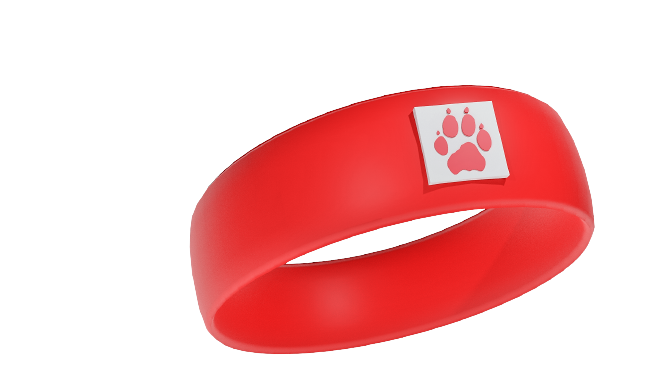
The Collar
Built from the inside out
iCollar is a sealed band of silicone, safe wiring, and even safer modules — each layer has a job. Here is how the pieces fit together, including two earlier design studies that shaped the product you wear today.
What lives inside the band
Energy & charging
A curved lithium-polymer cell follows the collar arc. USB-C (production) or micro-USB (early builds) tops up the pack; wireless Qi charging was validated in later mold iterations.
Brain & radios
An ESP32-based main board runs firmware, Wi-Fi/BLE, and LTE-M backhaul. Ceramic antennas sit on the PCB so the collar stays connected without external stubs.
GPS fix
A dedicated GNSS module (u-blox NEO-6M in early prototypes) sits under a protective shield with its patch antenna layered above — the fix engine for live location.
Structure & rescue
Encapsulating silicone and an inner NFC pocket (26 mm) let anyone tap-to-rescue even when the battery is flat. Quick-release hardware completes the band.
Earlier design prototypes
Before the shipping Ember Red finish, we iterated in CAD and bench builds. These two studies document how modules were arranged — and why the final collar keeps GPS, power, and NFC reachable without bulk.
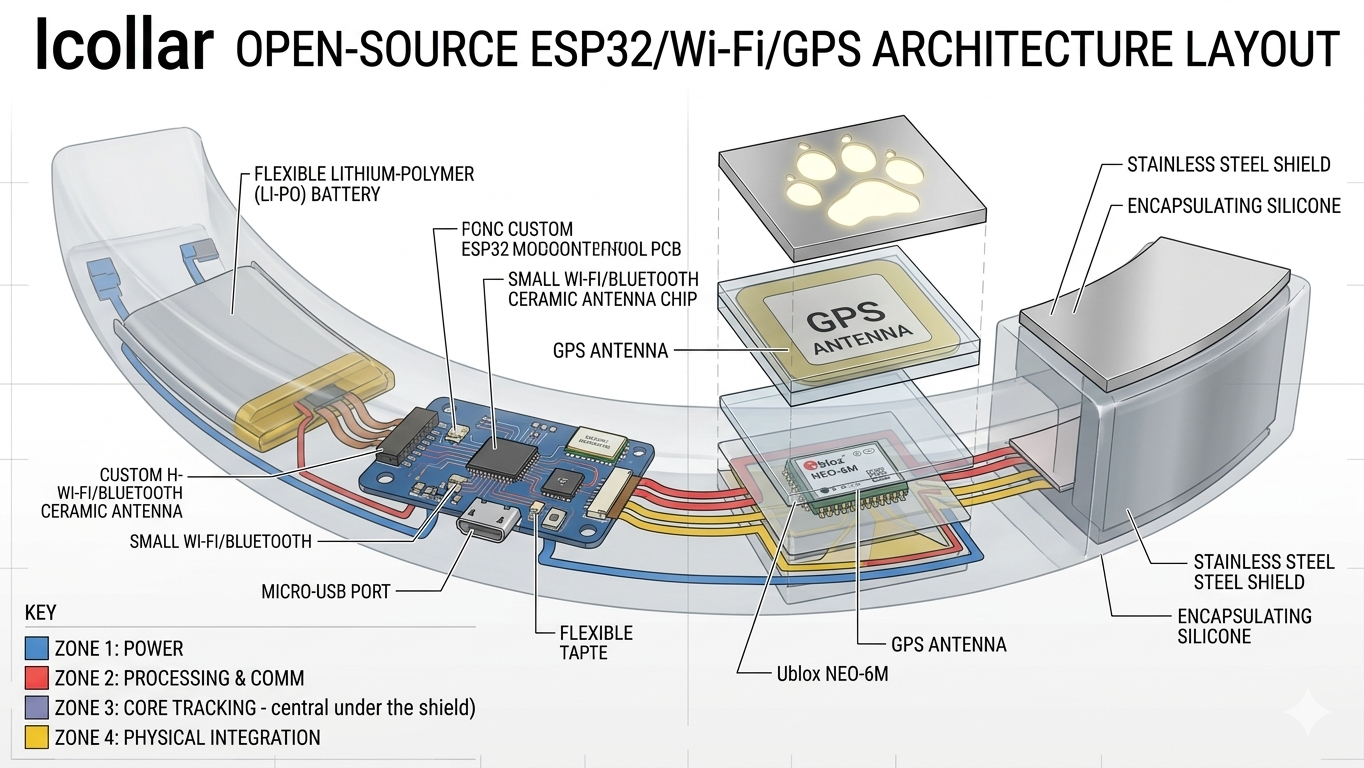
Early open-architecture layout: four color-coded zones show how power, ESP32 processing, GPS core, and NFC rescue hardware stack inside the curved silicone body.
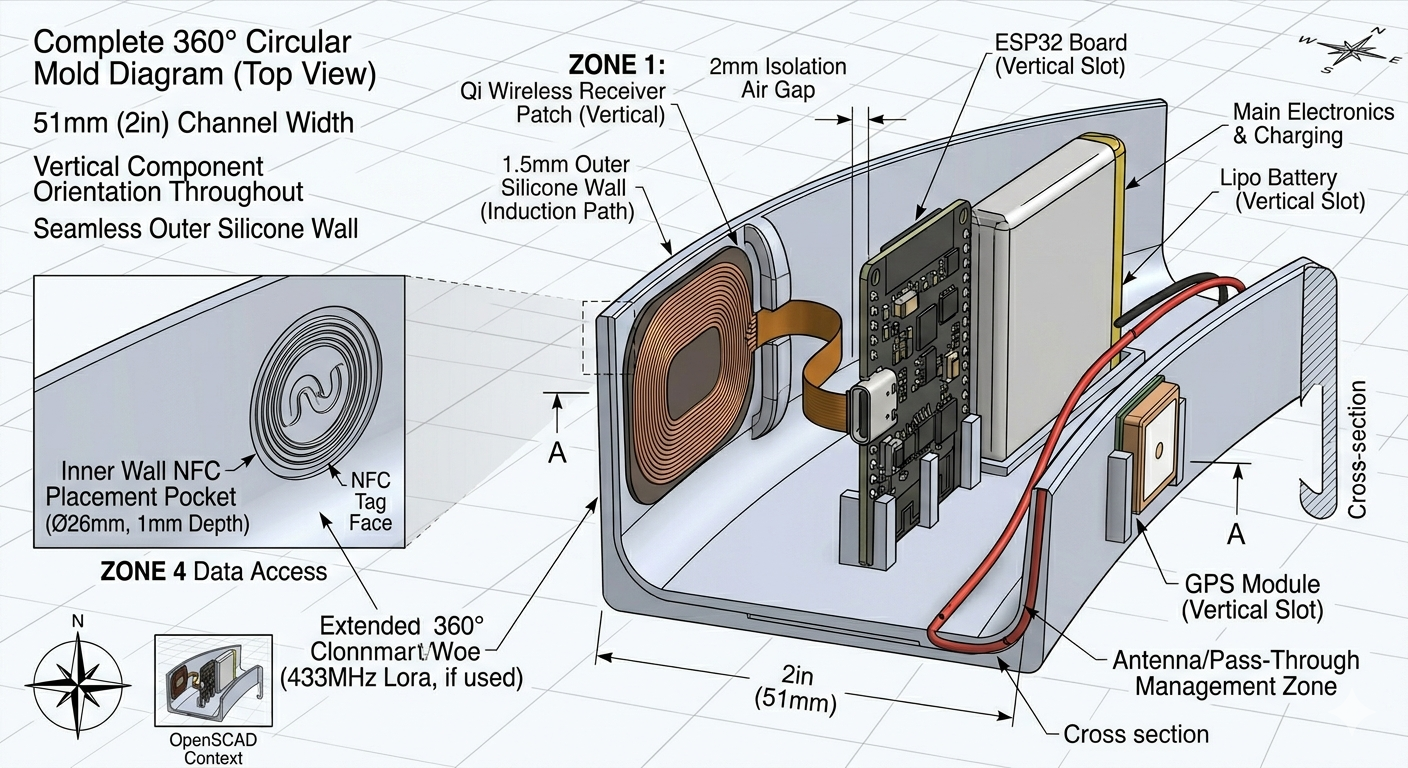
Circular mold study: modules mount vertically in a 51 mm channel — Qi receiver on the outer wall, ESP32 and LiPo in center slots, GPS on the inner arc, and an NFC pocket on the inside face for tap-to-rescue. We removed metal shielding for cleaner protection and a stronger antenna signal.
Production collars pair over BLE in the iCollar app and stream live telemetry to your dashboard. Questions? hello@icoll.ar